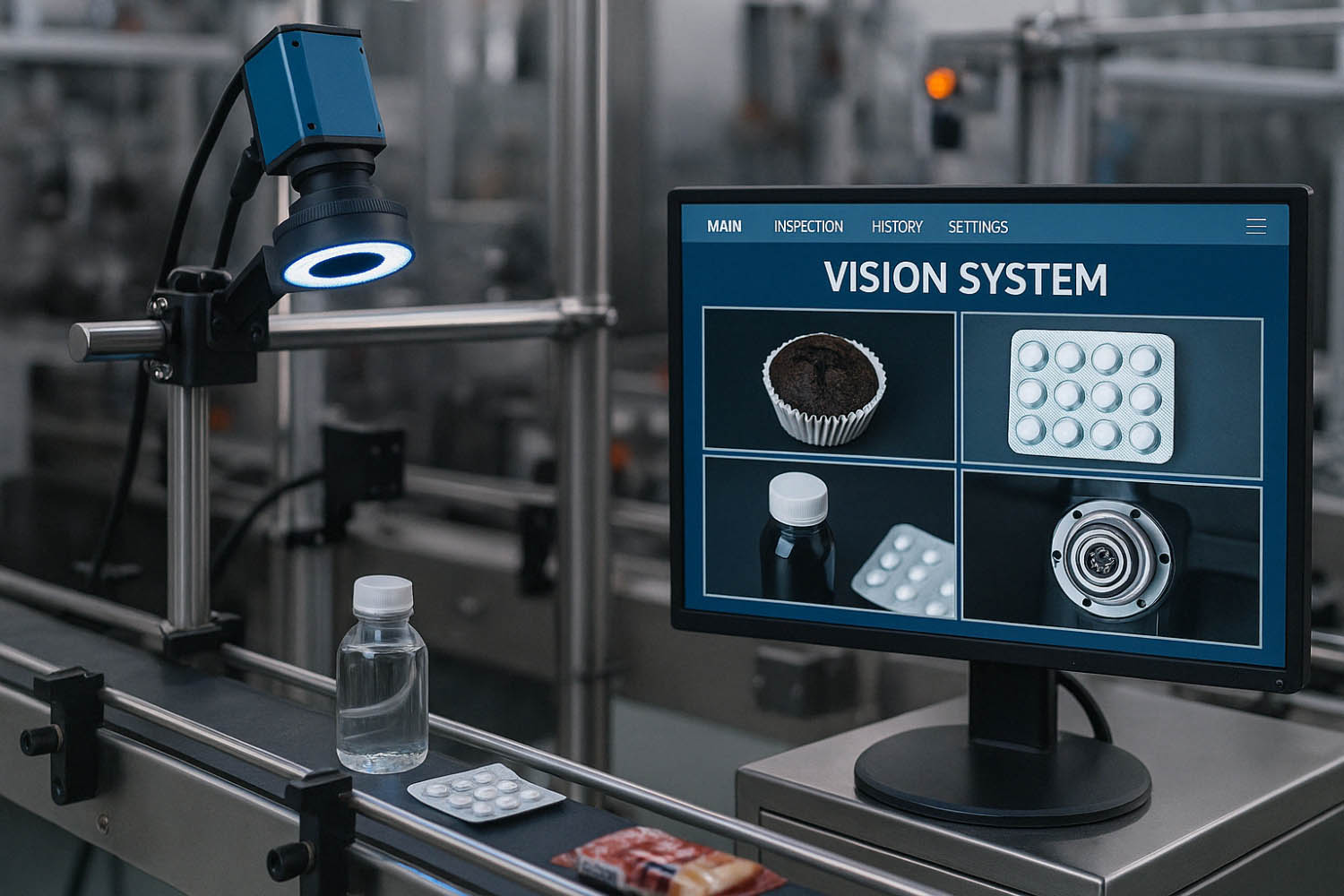
False Reject Reduction with AI: more accurate industrial quality control
11 - 02 - 2026
In industrial quality control, there’s a silent enemy that costs money every day: false rejects — good products that the system flags as defective. The outcome is predictable: waste, rework, stoppages for adjustments, and lower efficiency.
The good news: achieving false reject reduction in a stable way is now possible thanks to AI-powered machine vision (Deep Learning), which can adapt to real-world product and environment variability.
What are false rejects and why do they happen?
A false reject occurs when the system detects a “defect” that is actually within tolerance.
This often happens with rigid, rule-based inspection (thresholds, filters, fixed parameters). These approaches can work in ideal conditions, but performance drops when typical factory variables change:
-
Lighting variation (shadows, reflections, aging LEDs)
-
Color/texture changes by batch or supplier
-
Minor shape variations (organic products, flexible packaging)
-
Vibration, dust, humidity, or small positioning shifts
Direct consequence: the system becomes “too strict” and starts rejecting good product.
The real impact of false rejects on a line
False rejects don’t just waste product — they disrupt operations.
-
Higher waste and unit cost
-
More rework (labor + time)
-
Stops to recalibrate or “tweak parameters”
-
Less consistency (works one day, not the next)
-
More friction between production and quality teams
The solution: false reject reduction with machine vision + AI
Deep Learning adds a key capability: generalization.
Instead of relying on fixed rules, the model learns from real examples and can separate real defects from acceptable variation, even as conditions change.
At AIS Vision Systems, this approach is implemented with Rosepetal Deep Learning software, enabling inspection that is:
-
Adaptive (learns real product variability)
-
Robust against lighting or appearance changes
-
Consistent over time, with less manual tuning
-
Measurable, with clear metrics for audit and continuous improvement
Typical cases where AI reduces false rejects
False reject reduction is especially noticeable in:
-
Labels & sleeves: minor wrinkles, glare, small acceptable misalignment
-
Caps: tone variation, reflections, light surface marks
-
OCR / codes / batches: uneven printing, varying contrast, complex backgrounds
-
Food packaging: organic products, non-uniform textures, natural variation
AIS solutions to reduce false rejects
AIS REV 360
360° inspection for cylindrical containers with Rosepetal, ideal for detecting real defects on labels, sleeves, or caps without penalizing normal variation.
AIS Hopper – 360° cap inspection
A dedicated system for cap positioning and quality verification, designed for stability and reduced erroneous rejects at high speeds.
Advanced OCR and reading
High-accuracy verification of codes, batches, and text, minimizing reading errors that lead to false rejects.
Direct benefits on the factory floor
With AI-driven machine vision focused on false reject reduction, you can achieve:
-
Less waste without lowering quality standards
-
More stable production (fewer stops, fewer readjustments)
-
Better OEE through fewer incidents
-
More consistent inspection criteria (less reliance on “expert operators”)
-
Better traceability and data for continuous improvement
Want to reduce false rejects on your line?
If your line is rejecting good product or requires constant parameter tuning, it’s time to move to smarter inspection.
Contact AIS Vision Systems — we’ll help you evaluate your case and achieve false reject reduction without compromising quality.